
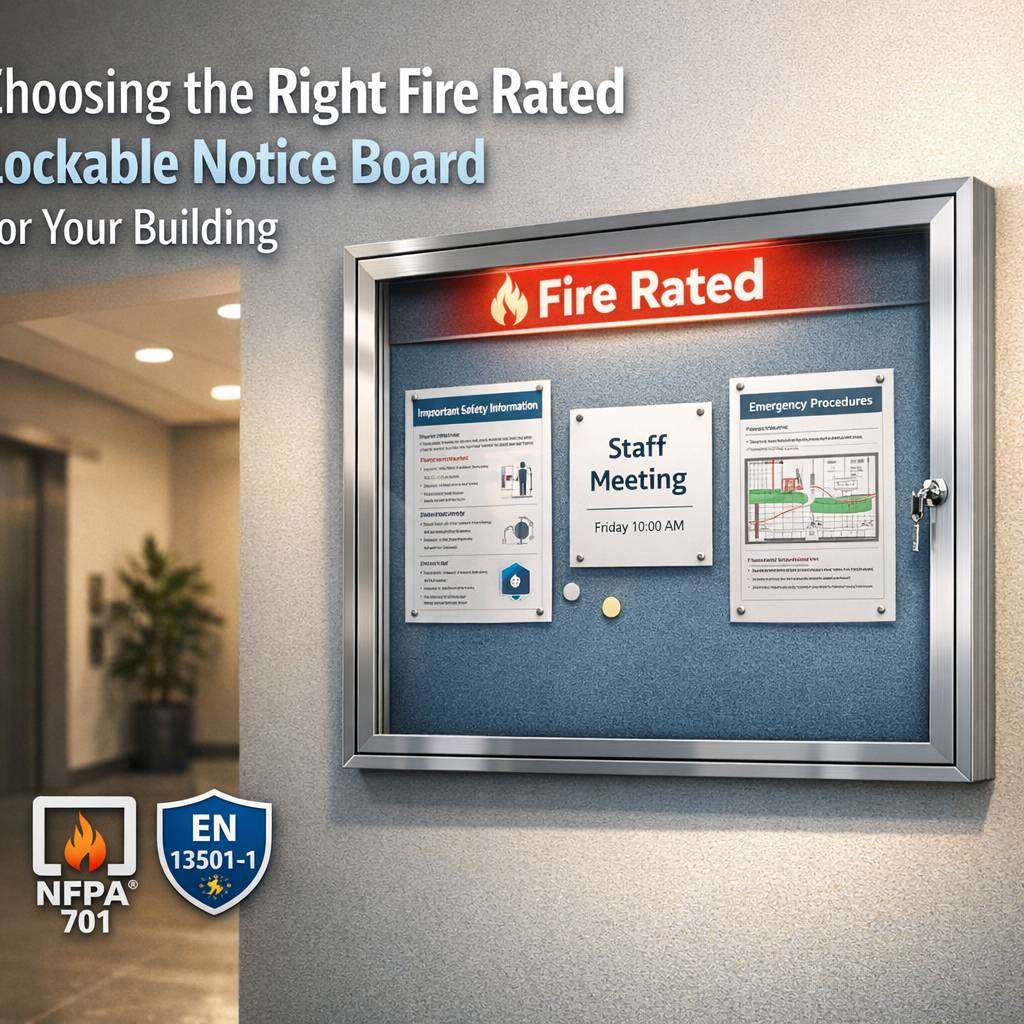
In any professional or public building, disseminating important information securely and safely is crucial. Fire safety requirements, durability, and user accessibility all influence the choice of notice boards. This article provides expert guidance on selecting the right fire rated lockable notice board, leveraging the benefits of fire retardant and flame retardant materials to protect both information and occupants.
Fire Rated Notice Boards
Fire rated notice boards are designed to resist heat and prevent rapid damage during a fire, helping to protect important notices, evacuation plans, and safety instructions. When evaluating options, assess the listed fire rating, such as 30, 60, or 120 minutes, as specified by relevant standards. A higher rating typically indicates greater resistance to heat and flame, which can be crucial in corridors, stairwells, and public access areas. Look for products that have independent third-party certification and clear documentation of their fire performance, including heat exposure tests and smoke development data.
Key considerations:
- Fire rating and compliance with local building codes.
- Compatibility with lockable hardware to ensure security without compromising accessibility.
- Durable, fire resistant materials that won’t degrade under heat.
Fire Rated Lockable Noticeboards
Lockable notice boards combine security with fire performance, offering a secure enclosure for notices, posters, and crucial safety information. These are particularly valuable in schools, offices, and healthcare facilities where unattended boards could be vandalised or tampered with. When selecting fire rated lockable notice boards, verify that the locking mechanism is robust and tamper-evident, and ensure the lock operates smoothly under varied temperatures. The enclosure should maintain its integrity during a fire, preventing notices from being displaced or damaged by heat and smoke.
Important features to review:
- Lock type (cam, roller, or modern electronic options) and ease of operation for staff and visitors.
- Seal quality around the door to resist smoke ingress and maintain a degree of fire resistance.
- Compatibility with wall fixing systems that maintain performance in fire scenarios.
Fire Retardant Noticeboards
Fire retardant noticeboards are designed with materials that slow down the ignition process and reduce flame spread. They are a practical choice for high-traffic areas where notices are updated frequently. Fire retardant materials also help maintain legibility of posted information as long as possible in the event of exposure to heat.
Points to check:
- Materials used for the board core and face panels (e.g., steel, aluminium, or fire-retardant composites).
- Surface coatings that resist scorching and prolong readability.
- How the board’s frame and fixings contribute to overall resistance to heat and flame.
Fire rated lockable notice boards provide secure, durable messaging solutions for high-risk environments. For more product details and options, explore the range at https://www.displaydevelopments.co.uk and ensure your spaces meet safety standards with reliable access control.
Flame Retardant Notice Boards
Flame retardant notice boards share similarities with fire retardant boards but focus specifically on slowing the spread of flame rather than withstanding structural collapse. They are often designed for interior environments where aesthetic considerations matter as much as safety performance.
Consider these aspects:
- Certification for indoor fire performance and any required maintenance to preserve retardant properties.
- Surface finish that remains legible after exposure to heat, smoke, or condensation.
- Edge and corner protection to reduce damage from impacts or heat concentration points.
Fire Resistant Display Boards
Fire resistant display boards prioritise legibility and durability under fire conditions. They are suitable for environments where critical information must endure through a fire event, such as emergency procedure charts, muster points, and evacuation routes. The display surface should remain readable even when subjected to heat and smoke, and the board should maintain a protective enclosure around the notices.
Key attributes:
- High-contrast, durable display surfaces that resist warping and blistering.
- Clear weatherproofing and smoke seals around the display area.
- Easy replacement of notices without compromising the board’s integrity.
Fire Proof Bulletin Board
The term fire proof bulletin board is commonly used to describe boards that offer substantial protection against fire exposure. While no material is completely fireproof, reputable products are rated to withstand designated temperatures for specified durations. When selecting a fire proof bulletin board, review the rated duration, tested conditions, and whether the board includes a self-closing or self-cluttering mechanism to manage posted content securely.
Evaluation criteria:
- Verified fire resistance ratings and test standards (e.g., EN, NFPA, or other regional benchmarks).
- Construction quality, including steel or reinforced panels that resist bending and deformation.
- Security features such as vandal-resistant locks and anti-tamper hinges.
Fire Rated Display Boards
Fire rated display boards combine visibility with protection. They are ideal for reception areas, lobbies, and corridors where information must be both accessible and secure. The display board should be easy to update, with a design that accommodates standard sizes of notices, posters, or notices.
Practical considerations:
- Mounting options that fit the building’s structure and comply with fire safety clearance requirements.
- Visual design that supports readability under varying lighting and smoke conditions.
- Internal compartments that separate raw safety information from general notices, aiding rapid access during an incident.
Fire Rated Lockable Noticeboards
Fire rated lockable noticeboards are a specialised category that merges the security of a lockable system with proven fire resistance. These boards are particularly beneficial in areas with sensitive information or where unauthorised access must be prevented, such as HR notice areas, clinical settings, or secure administrative zones. When selecting, the priority should be an enclosure that remains intact, with a seal that minimises smoke ingress and a locking mechanism that remains functional under heat.
Selection tips:
- Ensure the lock and hinges are rated for heat exposure and meet relevant safety standards.
- Confirm the door closes fully and seals properly to maintain fire performance.
- Assess the ease of updating content for staff while ensuring the locking mechanism does not hinder routine tasks.
What to ask suppliers
- What is the board’s tested fire rating, and what standard was used?
- Are the materials and finishes compliant with relevant UK fire safety regulations?
- How easy is it to replace notices without compromising the board’s integrity or fire performance?
- Are there warranties or service plans for maintenance, including lock replacements and seals?
Practical installation tips
- Position boards in accordance with fire exit routes and escape plans, ensuring they are visible and accessible.
- Use appropriate wall fixings rated for the building’s structure and fire safety requirements.
- Schedule routine inspections to verify the integrity of seals, locks, and display surfaces.
In choosing the right fire rated lockable notice board, organisations maximise security without compromising safety. By understanding the distinctions between fire retardant noticeboards, flame retardant notice boards, fire rated noticeboards, and their lockable variants, facilities managers can select a solution that protects critical information while meeting fire safety obligations. The right board becomes a reliable, durable component of a building’s safeguarding strategy, supporting clear communication during normal operations and resilience in emergencies.